
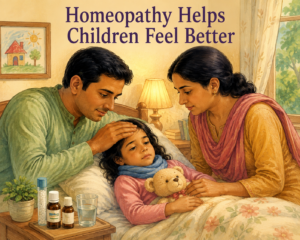
Homeopathy Helps Children Feel Better
Treating Acute Illnesses While Under Homeopathic Care
In homeopathy we believe there are two ways in which an acute illness manifests: one is a pure acute. In this case the patient’s usual symptoms are suspended, while he goes into a new state that is different from his usual state. This kind of acute illness may require an acute remedy, such as Aconitum napellus, Belladonna, Arsenicum album, Gelsemium sempervirens, Bryonia alba and others.
The second type of acute illness is an exacerbation or flare of the chronic state. In this type of acute, the patient’s usual chronic symptoms persist during the acute. If the patient is having difficulty recovering from such an acute illness, then they may need another dose of their constitutional remedy. Please send your homeopath an email if you or your child falls sick, so that the homeopath can determine what type of acute this is, whether an acute remedy is called for, or whether an oral or proximity dose of the constitutional remedy will be helpful.
Some people like to have a homeopathic 30C kit at home for emergency use. Homeopathic pharmacies will often sell remedy kits, such as Helios.co.uk, hahnemannlabs.com, homeopathyworks.com, and homeopathy.org.
From a homeopathic perspective, it is generally better not to give a remedy at the start of an acute illness, because the remedy can on occasion cause an exacerbation of the acute symptoms. It is preferable to let the patient’s own immune system try to overcome the acute. If the patient is having difficulty it is okay to give a remedy, but it is better to give it toward the end of the acute illness rather than in the earlier stages of it. Another reason for this is that a period of observation is very wise, because the nature of the acute reveals itself as more time passes.
A fever or acute illness that appears within weeks of taking a remedy can be a part of the healing response to the remedy. This should not be interfered with by administering a different homeopathic remedy.
In homeopathic practice, we often observe that following a febrile or acute illness that the patient’s usual or chronic symptoms are often better afterwards.
For a high or persistent fever, or where the patient is in pain, has difficulty breathing, is dehydrated, is unusually sleepy, or is having seizures, please seek medical attention. Please also let your homeopath know what is going on, so that they can guide you with homeopathic care. Your homeopath may also be able to suggest herbal tonics that can help during different acute illnesses.
I asked ChatGPT to create a list of symptoms that should be noted when a patient is ill. Here is the list that it gave me.
For a homeopathic evaluation, it is important to observe the whole acute picture, not simply the diagnosis or temperature. The most useful observations are:
- Onset: When did the illness begin? Was it sudden or gradual? What was happening beforehand?
- Emotional state: What was the patient’s emotional state around the time of the onset of the illness?
- Temperature: What was the highest temperature, how it was measured, how does it change through the day?, Does the patient feels hot, or chilly, or does he/she alternate between the two?
- Behavior and mood: Is the patient unusually irritable, clingy, frightened, restless, quiet, withdrawn, weepy, angry, confused, or wanting to be left alone?
- Energy: If the patient is a child, is he or she still playing or completely prostrated? Does the patient want to lie down? Is the patient restless?
- Sleep: Is the patient more or less sleepy than usual? Is the sleep restless? Does the patient have difficulty falling asleep or waking frequently? Is the sleep position unusual?
- Thirst: Is the patient more thirsty or less thirsty than usual? Are they drinking large quantities or frequent small sips of liquids? Is there a preference for cold, warm, or room-temperature drinks?
- Appetite: Increased, decreased, or absent? Any unusual cravings or aversions?
- Perspiration: Is the patient sweating? Where—head, face, chest, back, whole body? Does sweating make the person feel better or worse?
- Temperature preferences: Does the patient want to be covered or uncovered? Want fresh air? Want the room warmer or cooler?
- Pain: Where is it? What does it feel like? What makes it better or worse—movement, pressure, lying still, warmth, cold, eating, drinking, etc.?
- Discharges: Describe nasal mucus, cough/phlegm, vomiting, diarrhea, ear discharge, etc.—including color, consistency, odor, frequency and anything unusual.
- Stool and urine: Diarrhea or constipation? Frequency and appearance of stools? Is the patient urinating normally?
- Modalities: What clearly makes the patient better or worse—time of day, position, motion, rest, warmth, cold, fresh air, eating, drinking, company, being held, etc.?
- Unusual or characteristic symptoms: Is there anything particularly strange or different from the patient’s usual state. This information can be especially useful to the homeopath.
- The chronic symptoms: During the illness, are the patient’s usual chronic symptoms better or worse, unchanged, or temporarily absent? This would be particularly important to help distinguish between a pure acute and a flare of the chronic state.
- What is different about the patient during this illness compared with how he or she normally behaves?
- Medications/supports given: Tylenol/acetaminophen, ibuprofen, antibiotics, antihistamines, herbs, supplements, homeopathic remedies, etc.—including approximately when they were given and what happened afterward.
- Overall direction: Is the patient clearly getting better, clearly getting worse, or staying about the same?
Note: I would add one separate safety instruction: parents shouldn’t wait for a homeopathic assessment when a patient appeasrs seriously ill. Difficulty breathing, blue/gray coloration, seizure, stiff neck with severe illness, severe dehydration or very little urine, inability to awaken normally, severe or rapidly worsening pain, or another alarming change warrants prompt conventional medical evaluation.
Conclusion
I hope this information is helpful to you, and that you or your child recover quickly from the acute illness. Please contact your homeopath if you have concerns about how the recovery is progressing.
Wishing you health and happiness.
Deborah Olenev CCH RSHom (NA)
